
#169 – 2019 Vibes
Q2 2025 E-commerce Review

Hi 👋 - The second quarter was e-commerce’s best in a while. Growth improved, consumers kept spending, and executives worked their rotator cuffs. Tariff worries mostly fizzled, while companies shifted from cost cutting to disciplined, ROI-positive reinvestment – especially in AI, where results are finally hitting the P&L. As always, thanks for reading.
If you’re finding this content valuable, consider sharing it with friends or coworkers. ❤️
For more like this, consider subscribing. ❤️
Q2 Results – A Back-Patting Good Time
What a difference a quarter makes. After a few turbulent years, e-commerce exited the second quarter on firmer footing. From Etsy to Shopify, growth accelerated across the board1 . A few companies even shattered records: The RealReal posted peak GMV, revenue, and new consignors; ThredUp logged its best quarter for new buyer acquisition. The vibes haven’t been this good since 2019.
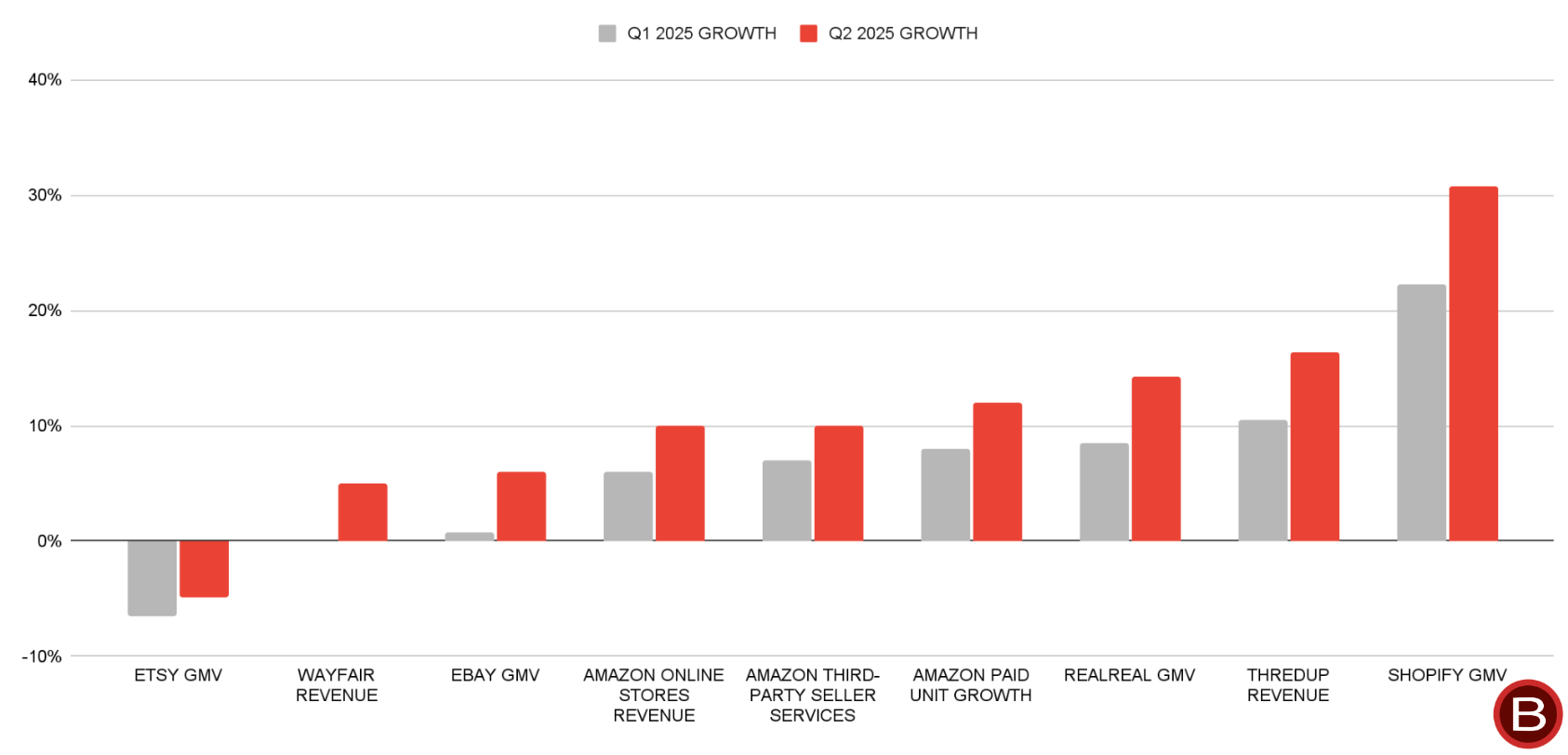
Broad trends tend to be more durable. That’s encouraging, as strength was widespread. Performance was solid across categories, with a few exceptions like furniture and home goods, where fortunes are tied to the moribund housing market.
Resilient US consumers did the heavy lifting. A secondary driver was that Temu and Shein pulled back from ad auctions in April, improving paid efficiency for eBay, Etsy, and ThredUp.
With growth back, so were victory laps. From ThredUp's “humming marketplace” to Wayfair’s “resounding success,” management teams were in a self-congratulatory mood. After a few years of inconsistent growth and cost cutting, managers now need to be concerned about back-patting bursitis.
Q3 Guidance – Momentum Rolls On
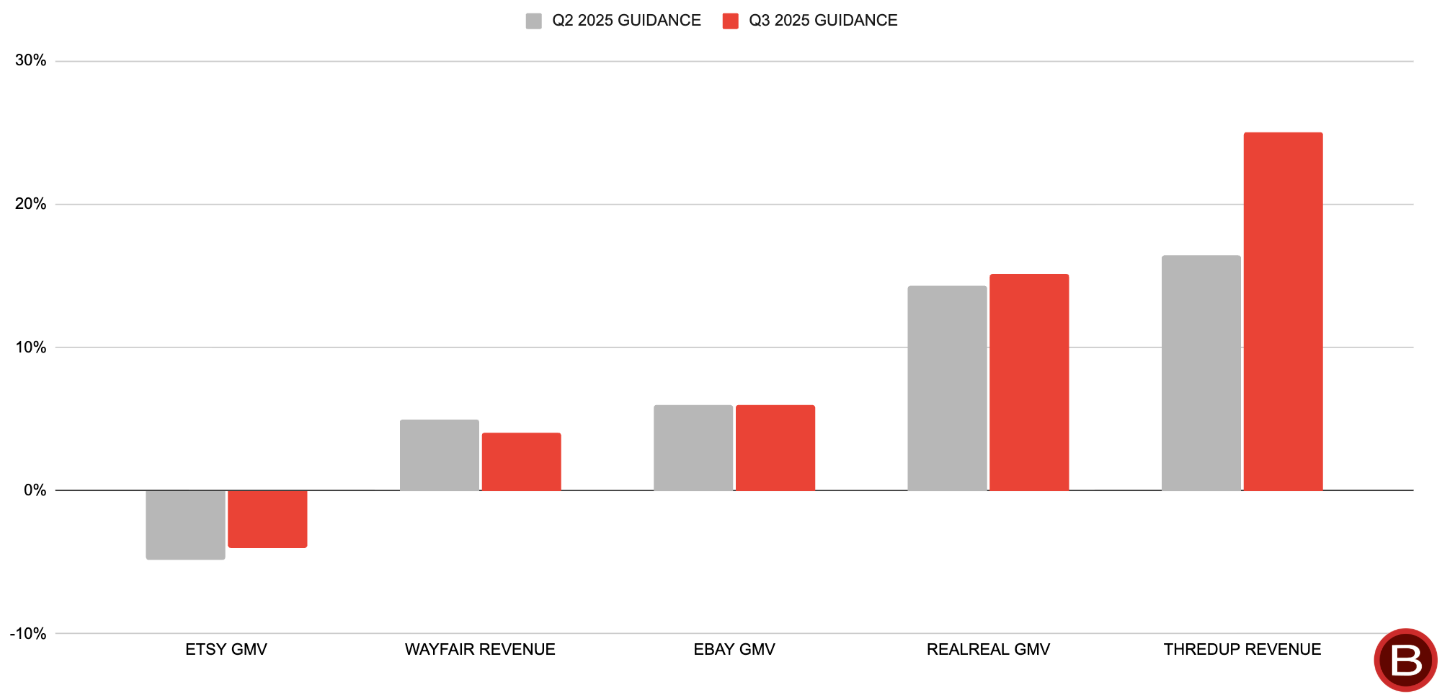
The second quarter wasn’t a fluke. Across the group, third quarter guidance skewed stable-to-better. eBay and Shopify said momentum carried into the July and August, and The RealReal highlighted steady revenue growth and supply intake. Etsy sounded more confident as new product features and marketing campaigns gain traction, though it stopped short of signaling a return to growth.
Consumer Behavior – Faster Delivery, Fuller Baskets
Underpinning the better vibes was the health of the US consumer. Despite sticky inflation, tariff noise, a cooler labor market (with a side of existential dread about AI taking jobs), and a frozen housing market, spending held up. While conditions remain choppy, references to inflation-weary shoppers delaying discretionary purchases mostly faded. Etsy even said that consumers looked slightly healthier versus the first quarter.
Though talking points changed, value kept winning. For example, Amazon's paid unit growth accelerated to 12% from 8% in the first quarter. Everyday essentials – consumables, health and personal care, home basics – drove growth, accounting for one-third of total units shipped.
Tariffs – Much Ado About Nothing (So Far)
Tariffs were the one macro topic that got a lot of airtime. For US-based companies, the impact to date has been neutral to mildly positive. (Temu and Shein likely feel differently.) In other words, previous tariff hand-wringing was in vain.
The feared combo – weaker demand and higher prices – hasn’t materialized. As Amazon CEO Andy Jassy put it on the second quarter call2:
There continues to be a lot of noise about the impact that tariffs will have on retail prices and consumption. Much of it thus far has been wrong and misreported. As we said before, it's impossible to know what will happen...What we can share is what we've seen thus far, which is that through the first half of the year, we haven't yet seen diminishing demand nor price is meaningfully appreciating.
eBay, Etsy and Shopify likewise reported no significant shift in cross-border flows, though Shopify noted that some merchants were raising prices.
Where tariffs might matter is in relative advantage. For example, ThredUp argued that closing the de minimis loophole would lift fast-fashion prices, sharpening secondhand’s value proposition. By the same logic, The RealReal could benefit as higher primary luxury prices filter into the secondhand market over time.
From Defense to Disciplined Offense
Capital allocation also saw a vibe shift. After two years of optimization, e-commerce players are pivoting to playing disciplined offense – investing where ROI is the clearest.
AWS illustrates this transition at a bird’s-eye view. As Andy Jassy put it3, enterprises have “resumed their march” to the cloud and are starting to deploy more AI applications, making him “optimistic about the AWS business.”
Chasing that “unusually large opportunity,” Amazon reported $31.4 billion in capex, largely for AWS, while also stressing cost-effective innovations and a path to higher margins over time.
On the core retail flywheel, Amazon’s recent investments are showing up in productivity. By re-architecting inbound fulfillment and expanding same-day nodes, it cut average package miles traveled by a package by 12% and handling touches by 15%. Similarly, same- and next-day deliveries grew 30%. Faster shipping unlocks higher purchase frequency, particularly for everyday essentials and perishables. Good things happen when you care about pennies, and Amazon keeps turning over the couch cushions.
Others are leaning in, selectively. eBay is reinvesting a portion of top-line upside into focus categories, C2C, eBay Live, and AI initiatives aimed at driving growth. Shopify believes its margin profile strikes the right balance between growth and profitability for now and is pushing growth while maintaining margins. ThredUp is taking a similar approach: maintaining margins while reinvesting to drive new buyers and grow supply.
AI – Big Hat, Some Cattle
AI is the exception to the above-mentioned frugality. After a year of all hat, no cattle, companies began quantifying gains from AI in the second quarter instead of just promising them.
Amazon highlighted that DeepFleet, an AI traffic management system for its one million warehouse robots, improved their travel efficiency by 10%, helping speed deliveries and reduce cost-to-serve. That sounds like science fiction, but the cost savings are real.
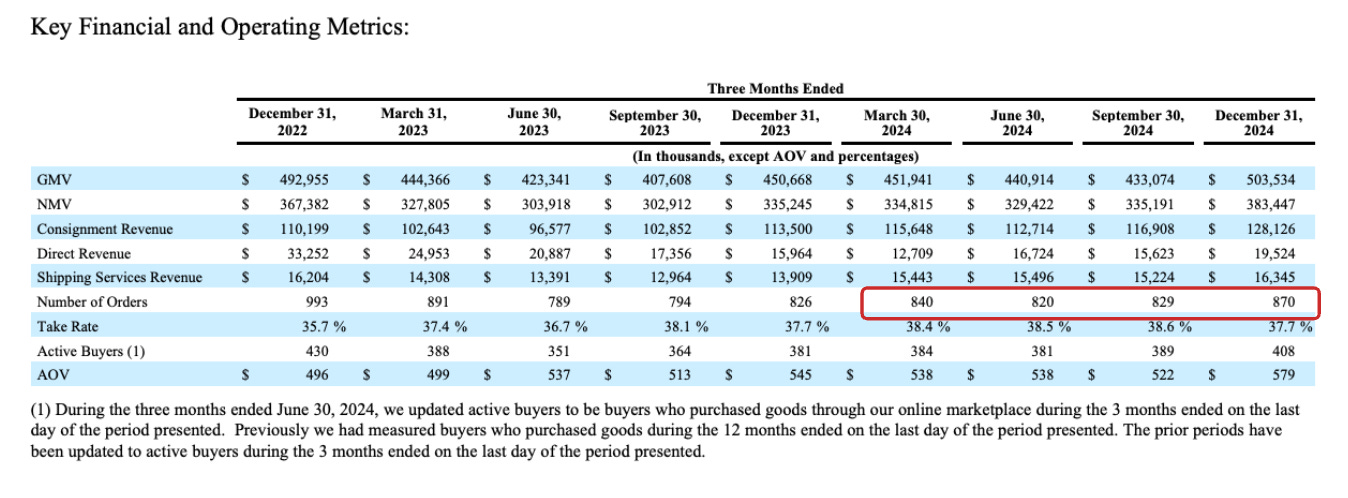
The RealReal is using AI to streamline its inbound processing, so supply hits the marketplace faster and cheaper. About 20% of new supply was processed with AI in the second quarter, with 30-40% by year-end. This is expected to “cut multiple dollars from processing costs per unit.4” Back-of-the-envelope: in 2024, the company had roughly 3.4m orders; saving $2 per order5 equates to $6.8 million in profit. For comparison, The RealReal expects adjusted EBITDA of $29-$32 million in 2025. That’s steak, not sizzle.
eBay said about 500 thousand new listings per day are created using gen-AI tools. (The company’s total supply base is over 2.4 billion listings.) It’s also using AI to optimize performance marketing, personalize marketing emails, and improve search and discovery. Similarly, Etsy is using AI to refine ranking, better understand intent, and improve CRM marketing.
At the infrastructure level, Shopify is building the plumbing for agentic shopping to help merchants plug into AI discovery and transact anywhere.
Of the group, Thredup’s P&L lift is most visible. Over the past 18 months, the company has infused AI into its product (NLP discovery, visual search). Results are starting to compound with conversion – the lifeblood of online marketplaces – up 18%. Higher conversion allows the company to spend more on performance marketing, juicing buyer acquisition. ThreadUp’s new buyers grew 74% in the second quarter, hitting a record.
AI is also reshaping distribution, making traffic a wild card. Risks abound. For instance, traffic to reference and health sites are down approximately 15% and 30% compared to last year, according to SimilarWeb.
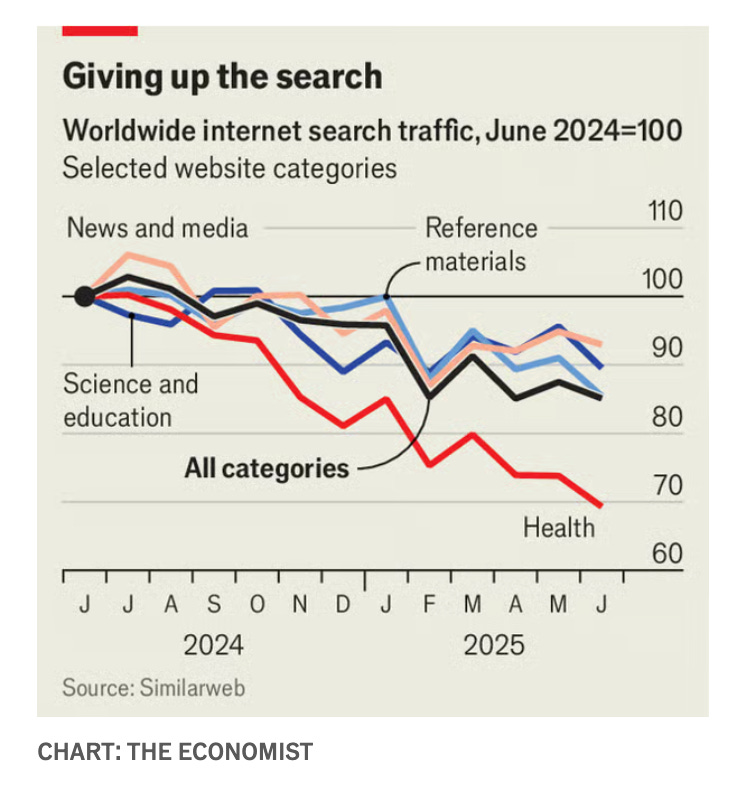
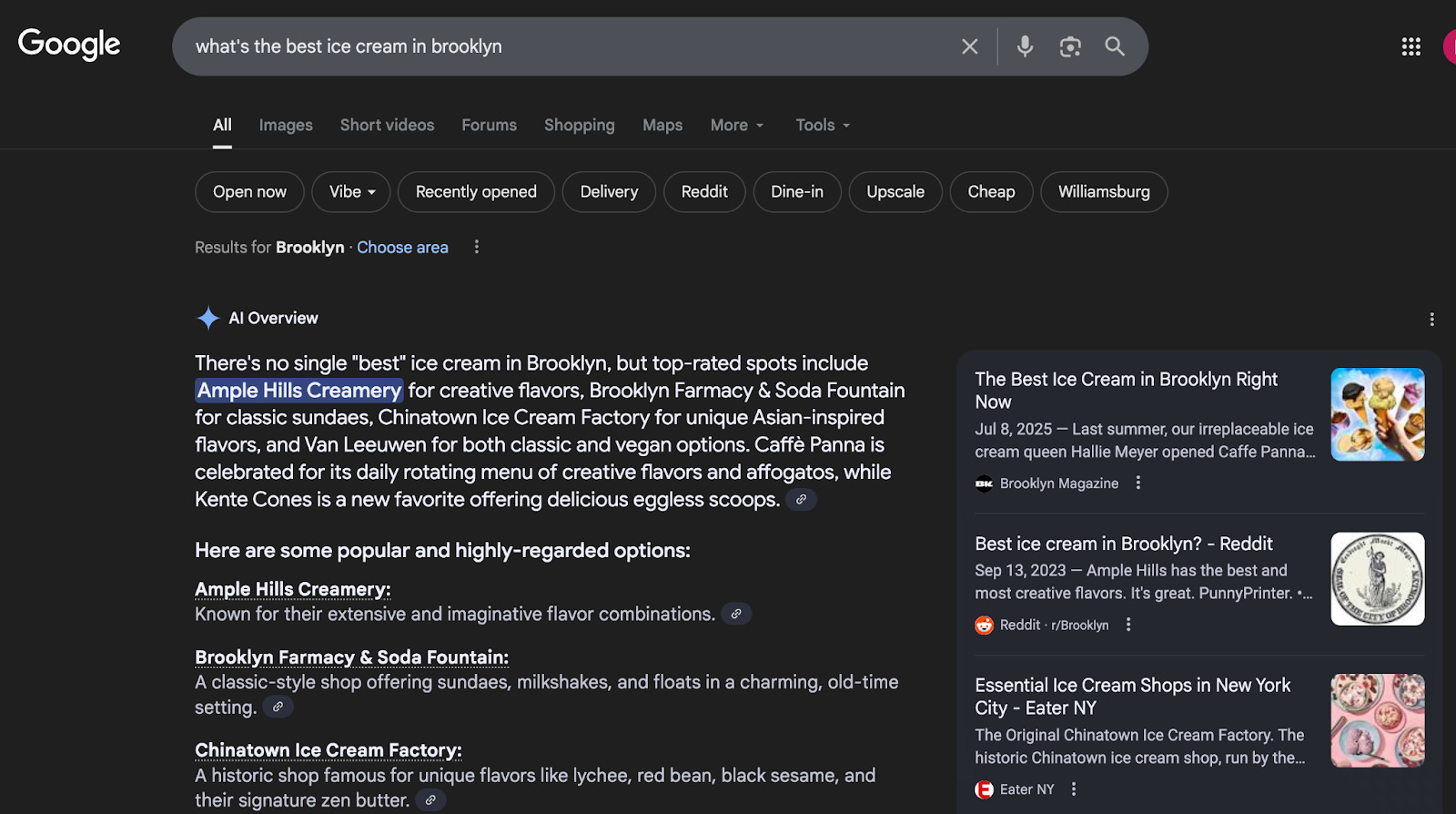
For e-commerce firms, the threat is twofold. First, if queries shift from Google to LLMs, that’s a risk to sites that Google currently showers with organic traffic. Second, as Google battles LLMs to maintain market share, it’s releasing more AI features – like AI Overviews – that push organic links further down the SERP. As the results below shows, the AI Overview pushed Yelp, Reddit, Eater and other organic links below the fold, which, as the old marketing joke goes, is where you hide the dead bodies. (The search also reveals some of AI’s current limitations: Chinatown Ice Cream Factory is in Manhattan. On the other hand, Ample Hills, Cafe Panna, and Van Leeuwen are all excellent.)
eBay, Etsy, and Wayfair all flagged LLM-driven traffic growing quickly off a very low base. Encouragingly, eBay noted high commercial intent on that traffic. Similarly, Etsy believes their supply of unique and differentiated supply is a plus. AI could benefit long-tail discovery, a point reinforced by Sundar Pichai Google in a recent podcast: with AI, Google is sending traffic to a wider range of sources and publishers.
Where this all heads is anyone's guess. The future, as always, is unpredictable. But a safe bet is that we’re going to be hearing a lot more about AI looking forward.
If you’re finding this content valuable, consider sharing it with friends or coworkers. ❤️
For more like this, consider subscribing. ❤️
More Good Reads and Listens
Move over SEO, NY Mag looks at GEO, optimizing sites for LLMs. Past quarterly e-commerce reviews from Below the Line: Q1 2025 – Tariffs, Tai Chi, and T-Shirts, Q4 2024 - A Strong Finish, A Fragile Start, Q3 2024 - Normal-ish, Q2 2024 - A Knife Fight In Mud, Q1 2024 – Keep It Simple, Q3 2023 – Back to Basics, Q2 2023 – Harvest Season, Q1 2023 – Nature is Healing, Q3 2022 – Naughty or Nice? (Part 1), Q3 2022 – Naughty or Nice? (Part 2), Q2 2022 – Slimming Down (Part 1), Q2 2022 – Slimming Down (Part 2), Q1 2022 – An E-commerce Recession (Part 1), Q1 2022 – An E-commerce Recession (Part 2).
Disclosure: The author owns shares of Alphabet and Shopify.

That’s a first since Below The Line started publishing these updates in Q2 2022.
Amazon, Q2 2025 Earnings Call, July 31, 2025. The company hedged a bit in the Q&A section, saying that uncertainty is high and these trends could change in the second half of the year.
Amazon, Q2 2025 Earnings Call, July 31, 2025.
The RealReal, Q2 2025 Earnings Call, August 7, 2025.
Orders can contain multiple items and not every item listed on the marketplace sells, so this estimate could prove conservative.
"Underpinning the better vibes was the health of the US consumer. Despite sticky inflation, tariff noise, a cooler labor market (with a side of existential dread about AI taking jobs), and a frozen housing market, spending held up."
Personally, this is the most surprising piece to me. The downbeat headlines on labor (particularly white-collar labor) would have believe that households would start tightening their belts, but evidently that isn't happening yet.